SheetVideo / Guides / Picking the parts

Pick the parts you can hear best

A score with several parts asks one question: what can you hear in the recording? SheetVideo listens for the parts you tick, so the clearer they are in the recording, the more precise the sync.

Runs in your browser · no account to start · a free account to export

What can you hear in the recording?, a band arrangement with the likely parts ticked

A seven-part band arrangement, with the parts likely to stand out ticked.

The way it is usually done
  1. Sync to every track in the file, heard or not
  2. Or only to your own part, buried under the band
  3. Watch the sync wander in the loud chorus

The sync listens for notes. It does best with the notes that are really there, loud and clear.

With SheetVideo
  1. Keep what stands out
  2. Leave out the rest
  3. Try again if a stretch wanders

No tapping beats. No tempo guessing. No keyframes.

Step by step

How to do it, click by click

Every picture below is the real SheetVideo editor, with what to click ringed and numbered. The example is SheetVideo’s own demo song (seven parts) over a neutral stand-in clip.

  1. 1Bring the score

    Step 2 asks for the notes you played: SheetVideo listens for them in the recording, and they are what ends up on the video. Here it is a MIDI file of the Nocturne: click MIDI and pick the .mid. Dropping the file on the window works too.

    The score decides how good the sync can be. MusicXML and Guitar Pro carry the notes and the bars exactly. MIDI is very good when it was written in a notation program, and weaker when it was played in or made in a quick online editor. A PDF reads well when it was exported from a notation program.
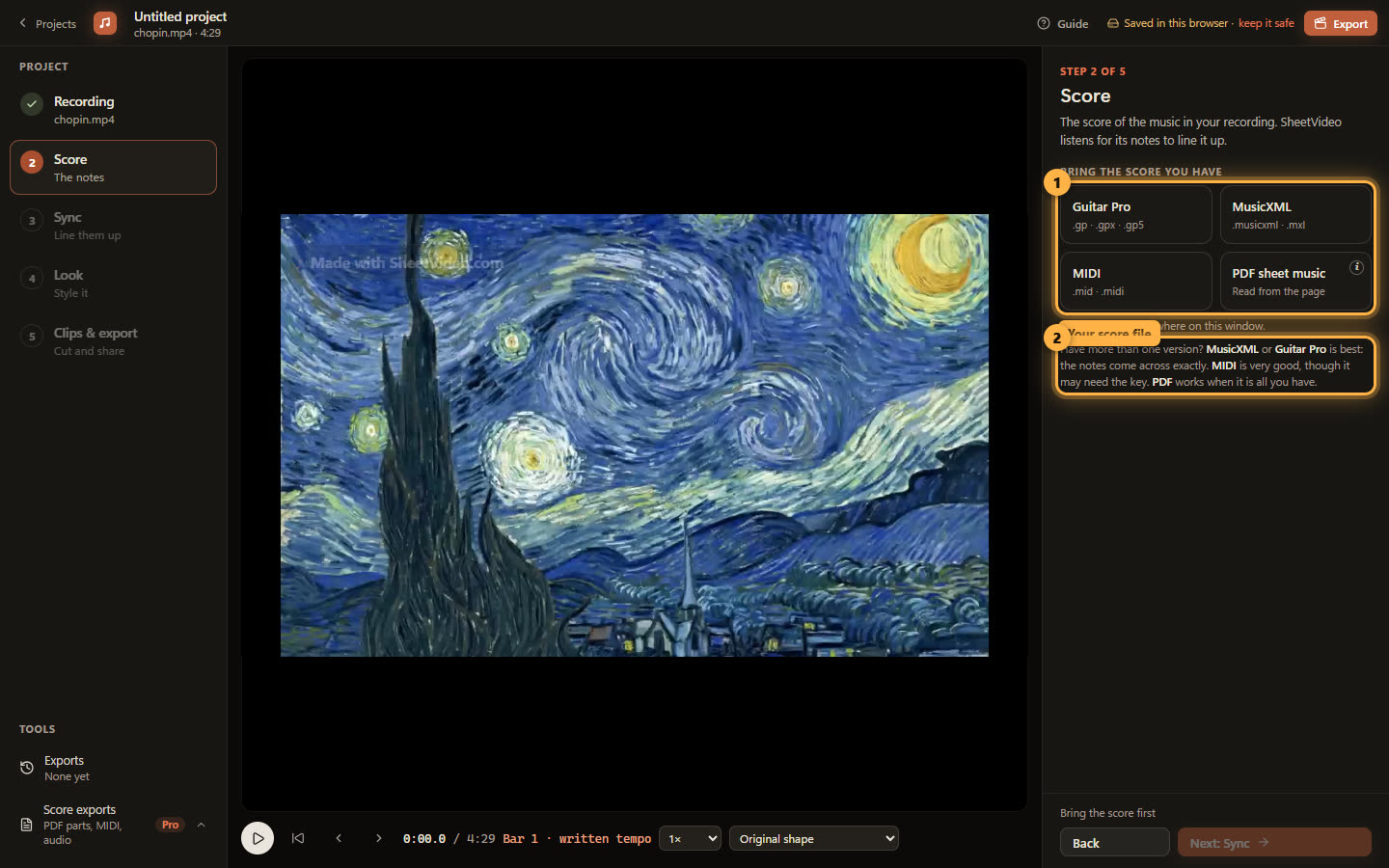
    The Score step with the score formats ringed
  2. 2Tick the parts you can hear best

    With several parts, SheetVideo asks what you can hear in the recording, with the likely parts ticked. Keep the ones that stand out most in the recording — the drums, a lead, the melody — and untick anything quiet, doubled or not in the recording at all. The more clearly they can be heard, the more precise the sync.
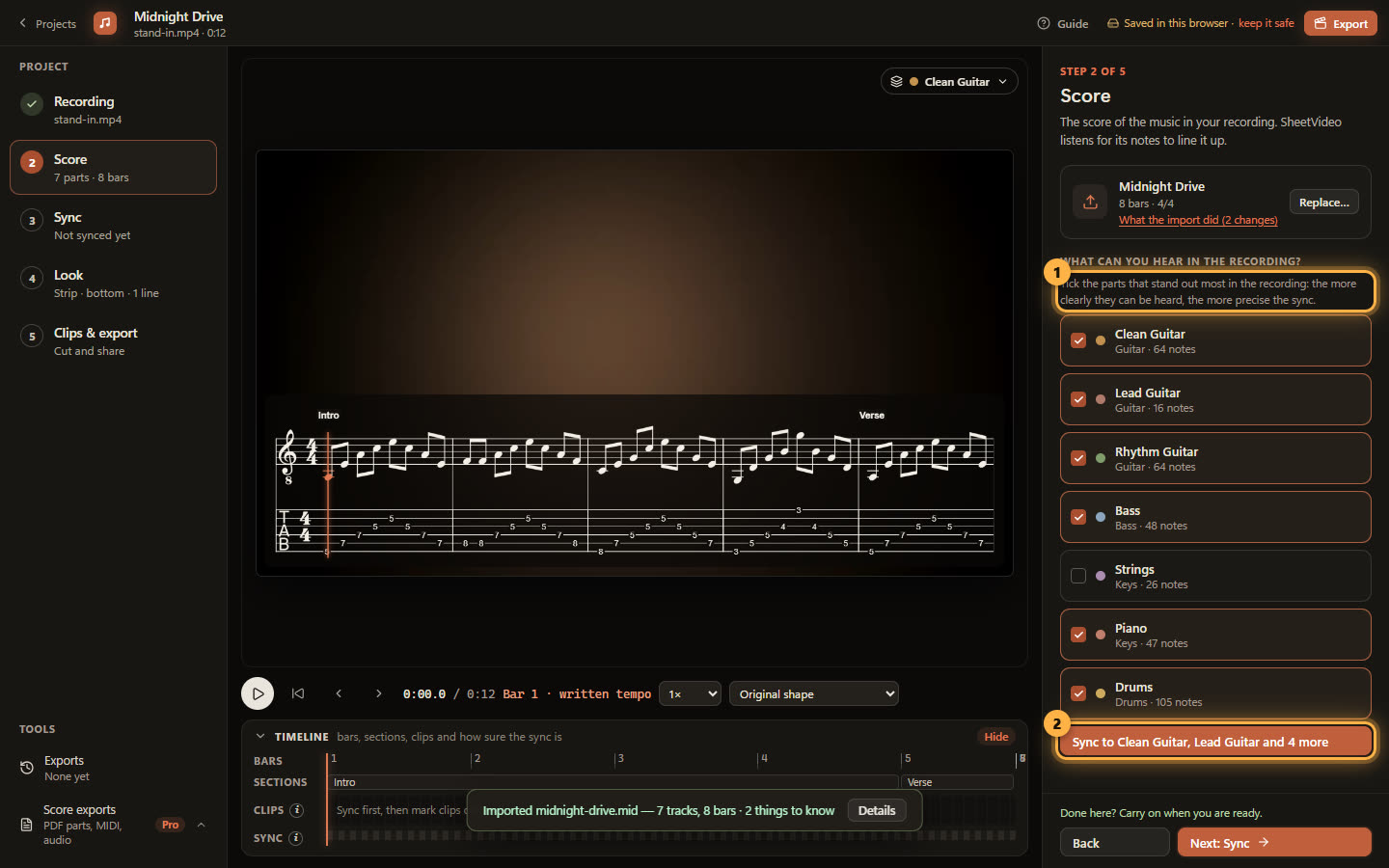
    What can you hear in the recording?, a band arrangement with the likely parts ticked
  3. 3If a stretch wanders, try other parts

    On the Sync step, Listening for shows the parts it used. Click it, tick or untick a part and sync again — adding the drums, or dropping a part you can hardly hear, is often all it takes. Your hand-placed fixes are kept.

In detail

In short

  • Playing alone: tick your own part
  • A whole song on the recording: the parts that stand out most — drums help the most, every hit a clear mark in time
  • Leave out quiet pads, doubled parts, and anything not in the recording
  • What is listened for and what is shown on the video are separate: sync on the band, show your part

How the sync works, and how close it lands on sixteen real piano recordings →

Questions

Try it on one of your own takes

Free in your browser, export included — up to 60 seconds a video, with a small mark. Pro exports the whole take without it.