How to do it, click by click
Every picture below is the real SheetVideo editor, with what to click ringed and numbered. The example is a recording of Chopin’s Nocturne in E-flat, Op. 9 No. 2.
1Start a project and add the recording
Open SheetVideo and start a new project — there is no account to make first. The steps down the left are the whole job: Recording, Score, Sync, Look, and Clips & export.
Step 1 is the recording. Click Choose a video… and pick the video of your performance. MP4, MOV and WebM all work, upright phone clips as well as landscape, and so does an audio file on its own.
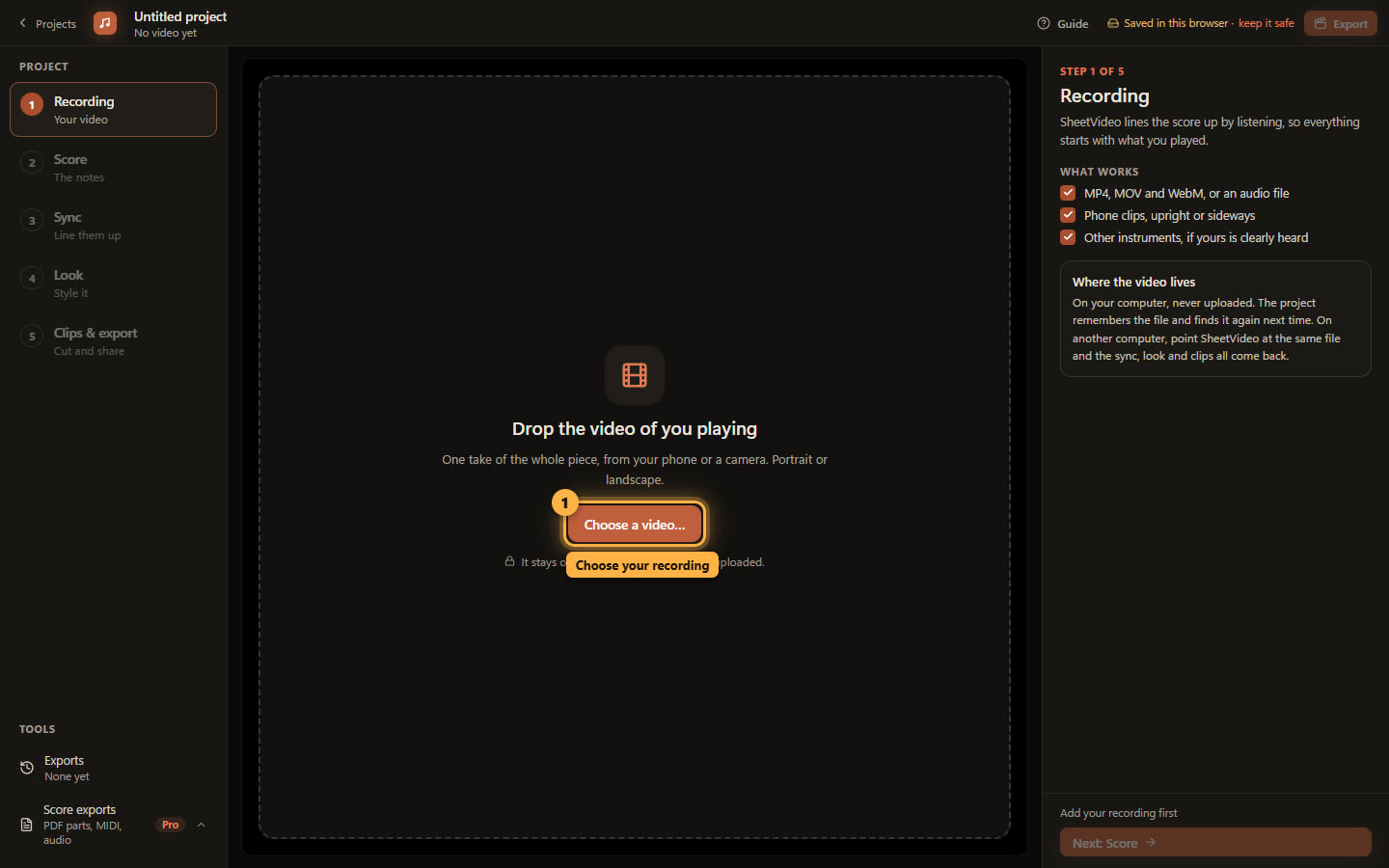
Step 1: Choose a video… The file stays on your computer — nothing is uploaded. 2Check the take, then move on
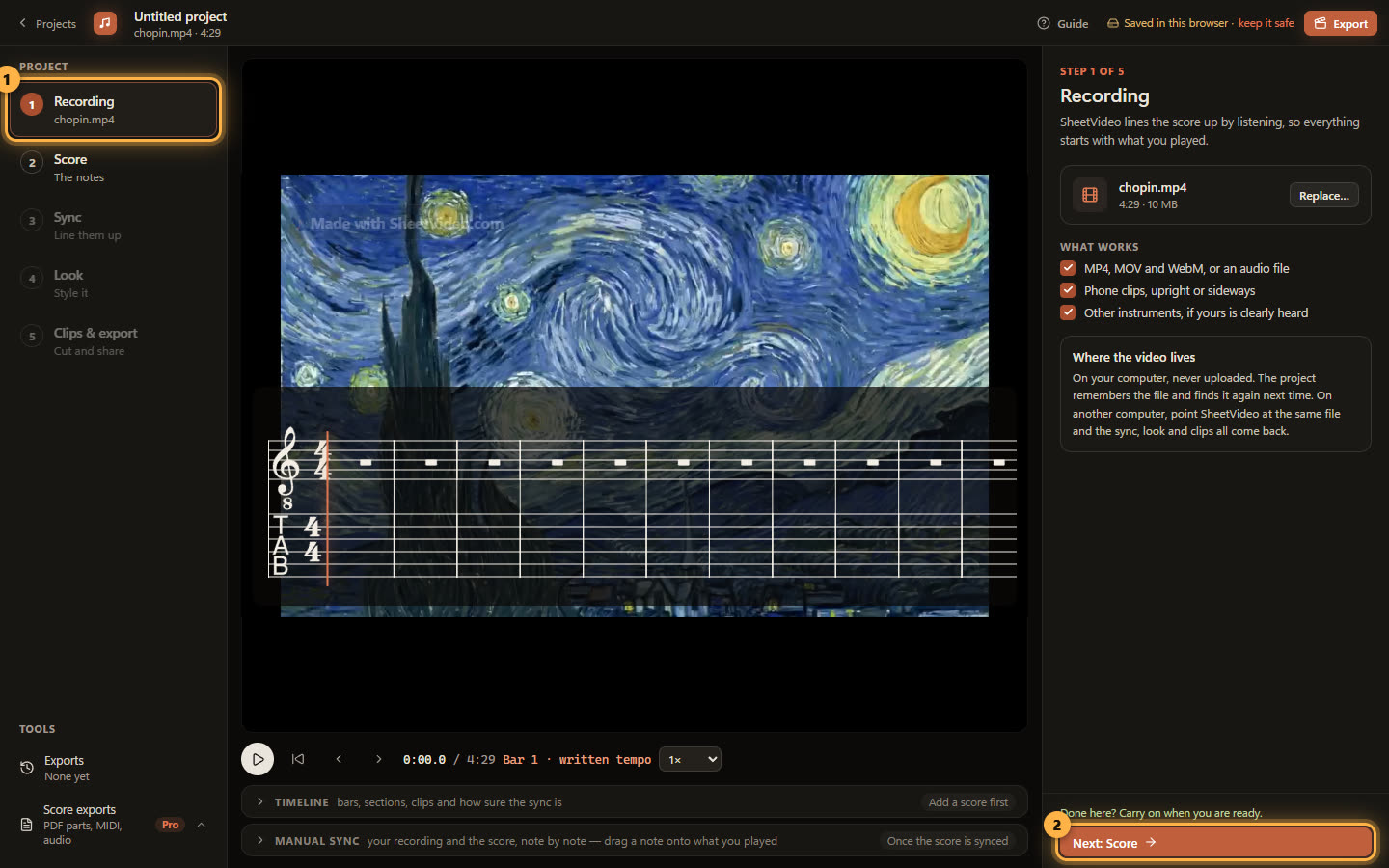
The video opens in the middle of the window and the Recording step turns green. You can play it and scrub it already; there is nothing to set here.
Talking, tuning or silence before the first note does not matter — the sync finds where the music starts on its own. Click Next: Score.
3Bring the score
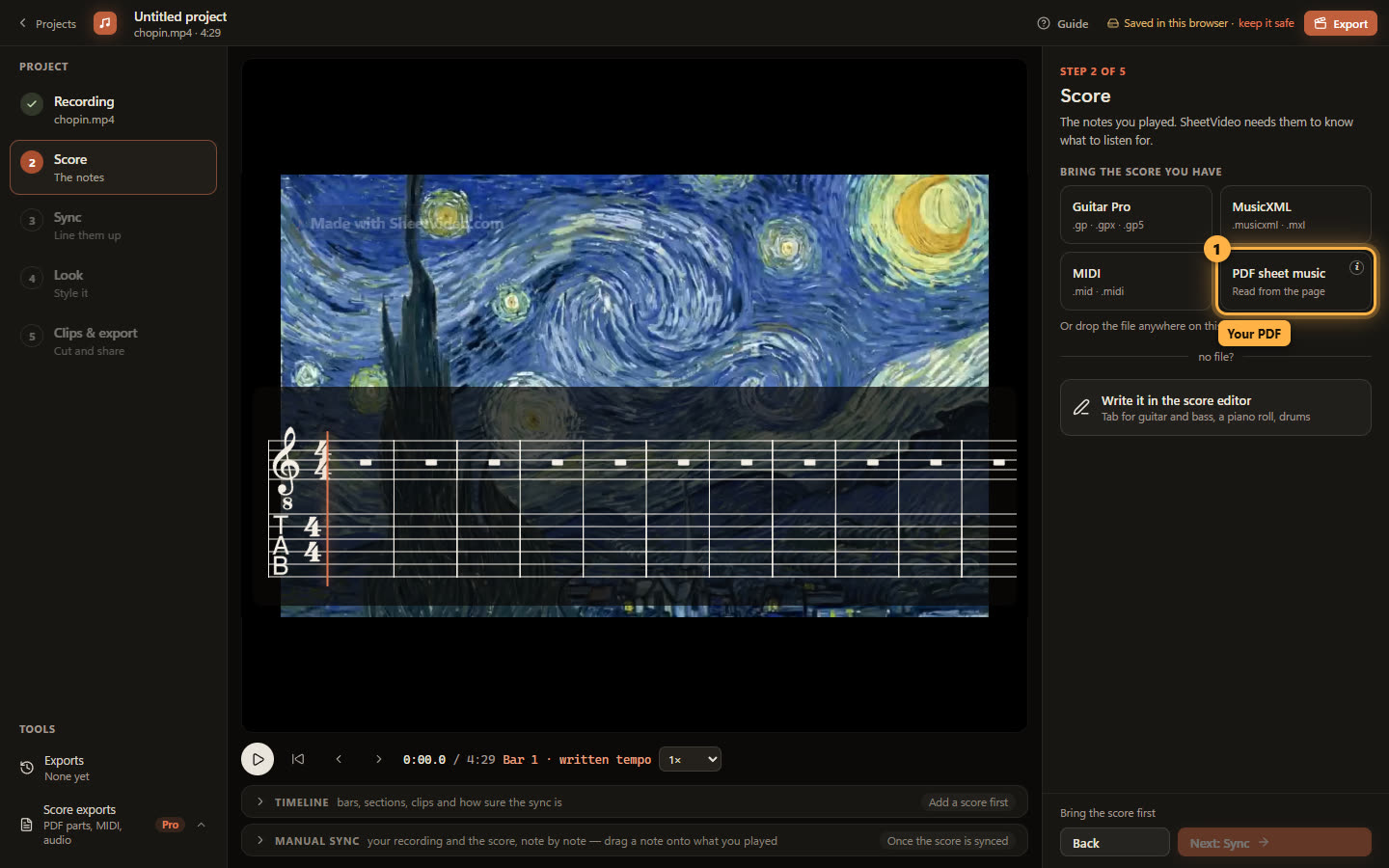
Step 2 asks for the notes you played. SheetVideo needs them to know what to listen for — and they are what ends up drawn on the video.
Click PDF sheet music and pick the PDF. You can also drop the file anywhere on the window. No file at all? “Write it in the score editor” opens tab, a piano roll and a drum grid.
4Check what the PDF reader found
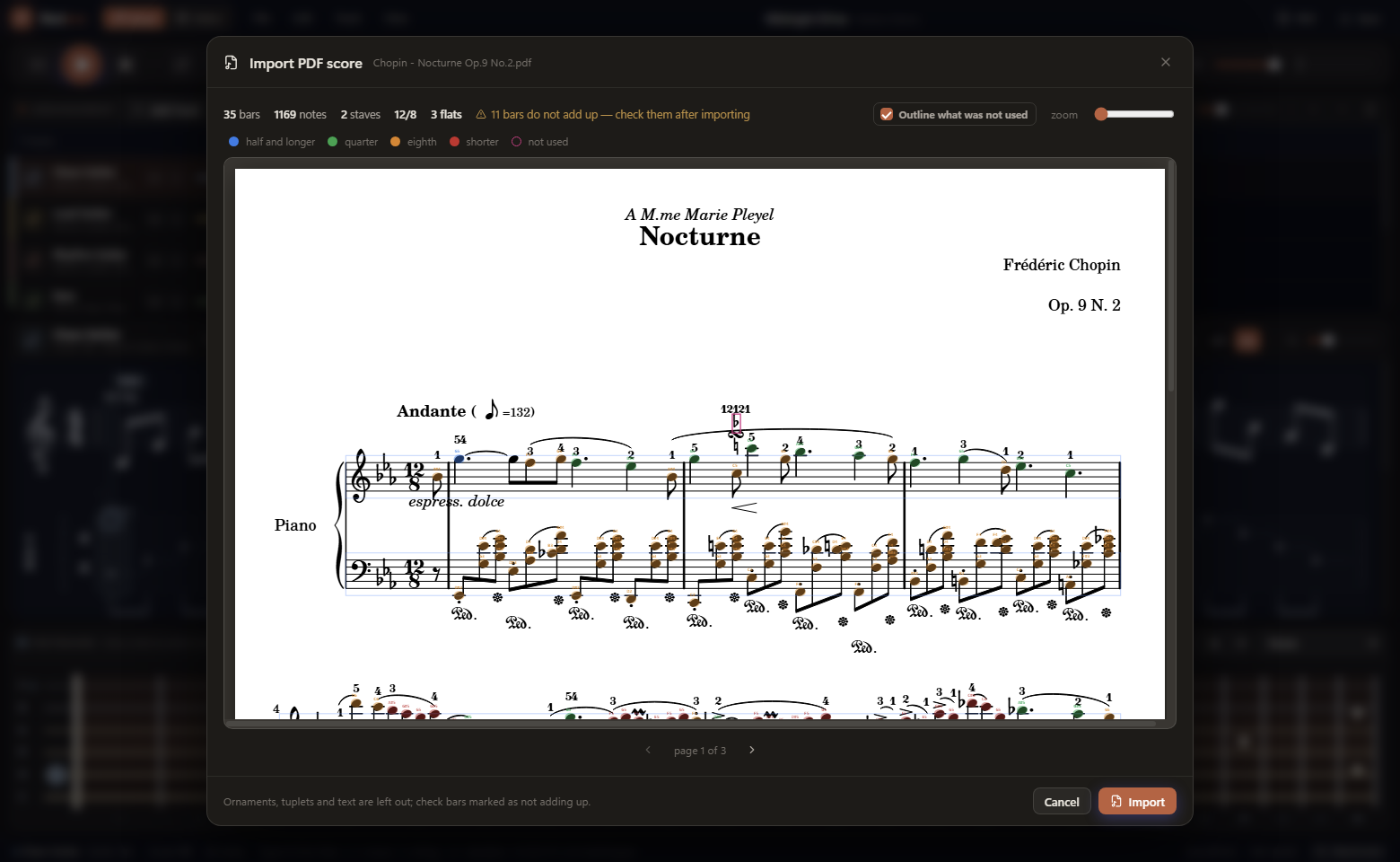
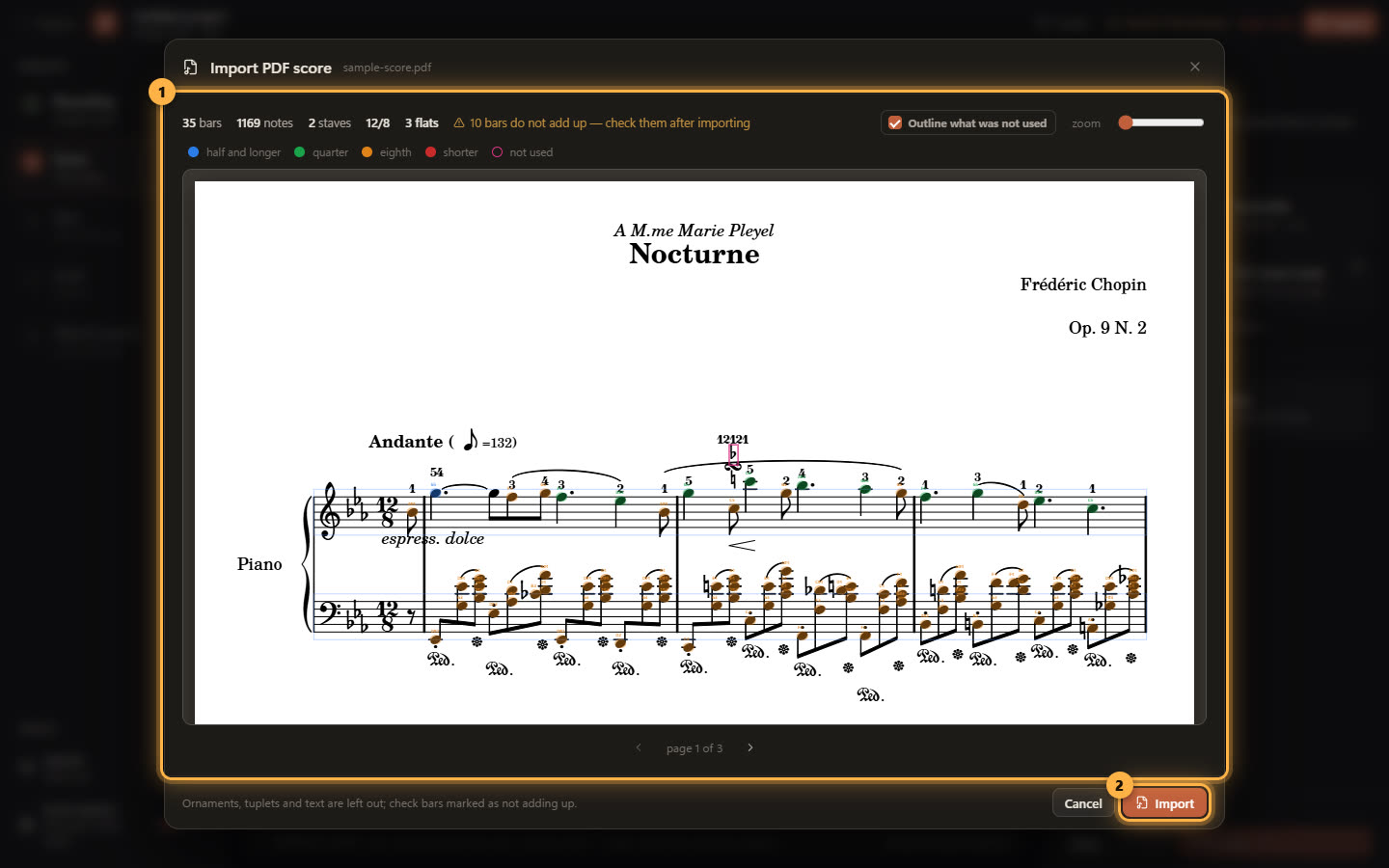
The PDF opens in a reader before anything is imported. For the Nocturne it found 35 bars on two staves in 12/8 with three flats — the key and time signature are inferred from the page. Every note is coloured by the duration it was read as, so a wrong one stands out.
Bars that do not add up are counted at the top and outlined on the page — ten here. The reader leaves ornaments, tuplets and text out, and the Nocturne has plenty of all three. Click Import, then check those bars in the score editor.
The pictures after this one were taken with the Nocturne’s MIDI version rather than the PDF. The steps from here are identical whichever file the score came from.
5Tell it which part you played
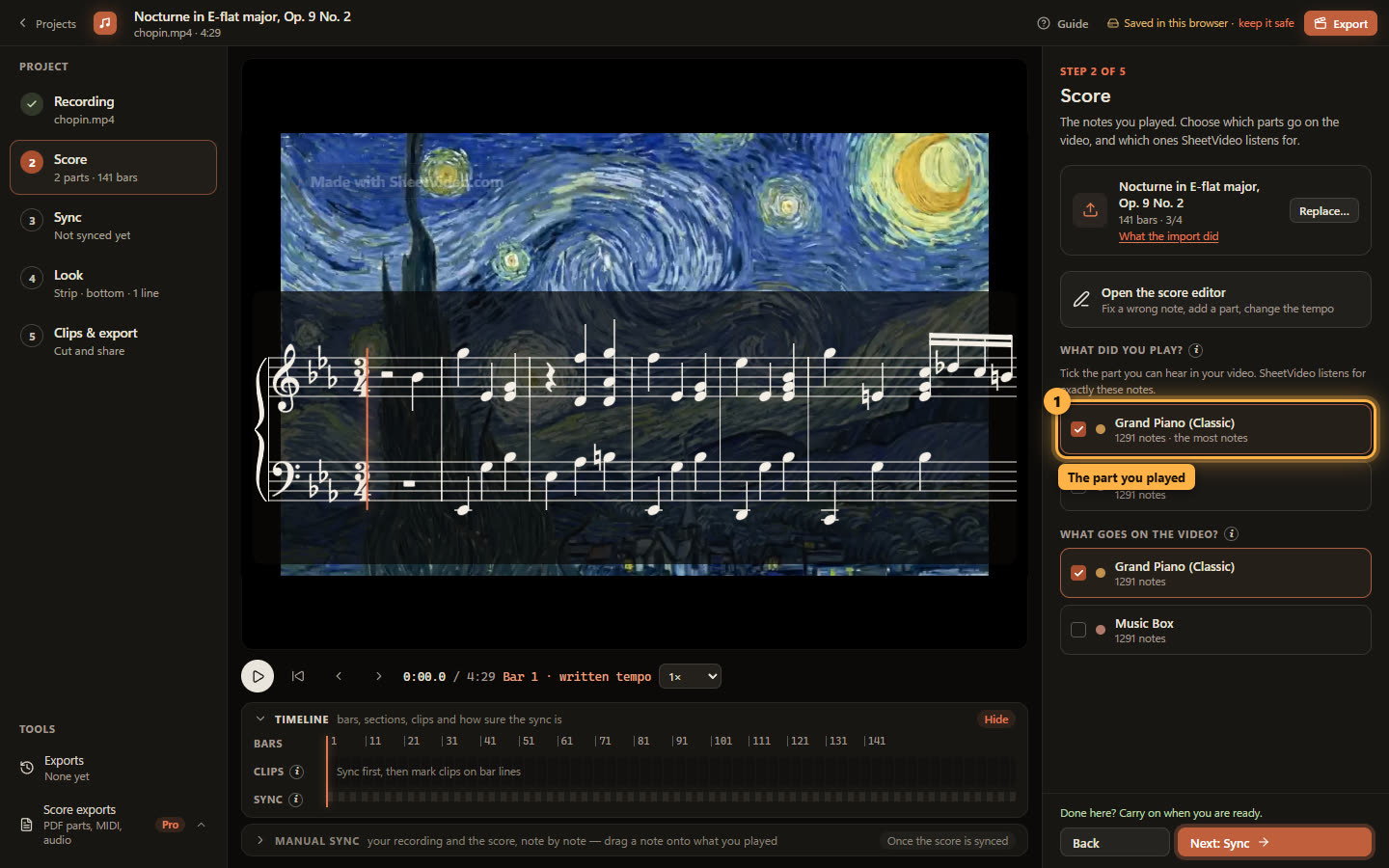
“What did you play?” is the most important choice on this step. SheetVideo listens for exactly the notes of the parts ticked here, so a part that is not in your recording — a backing track, a doubled line, somebody else’s part — makes it listen for notes that never sound.
This MIDI has a second part, Music Box, that only doubles the piano. It is not in the recording, so only Grand Piano is ticked. “What goes on the video?” below it is a separate choice: you can sync on one part and show another, or show several.
6Press Sync score to video
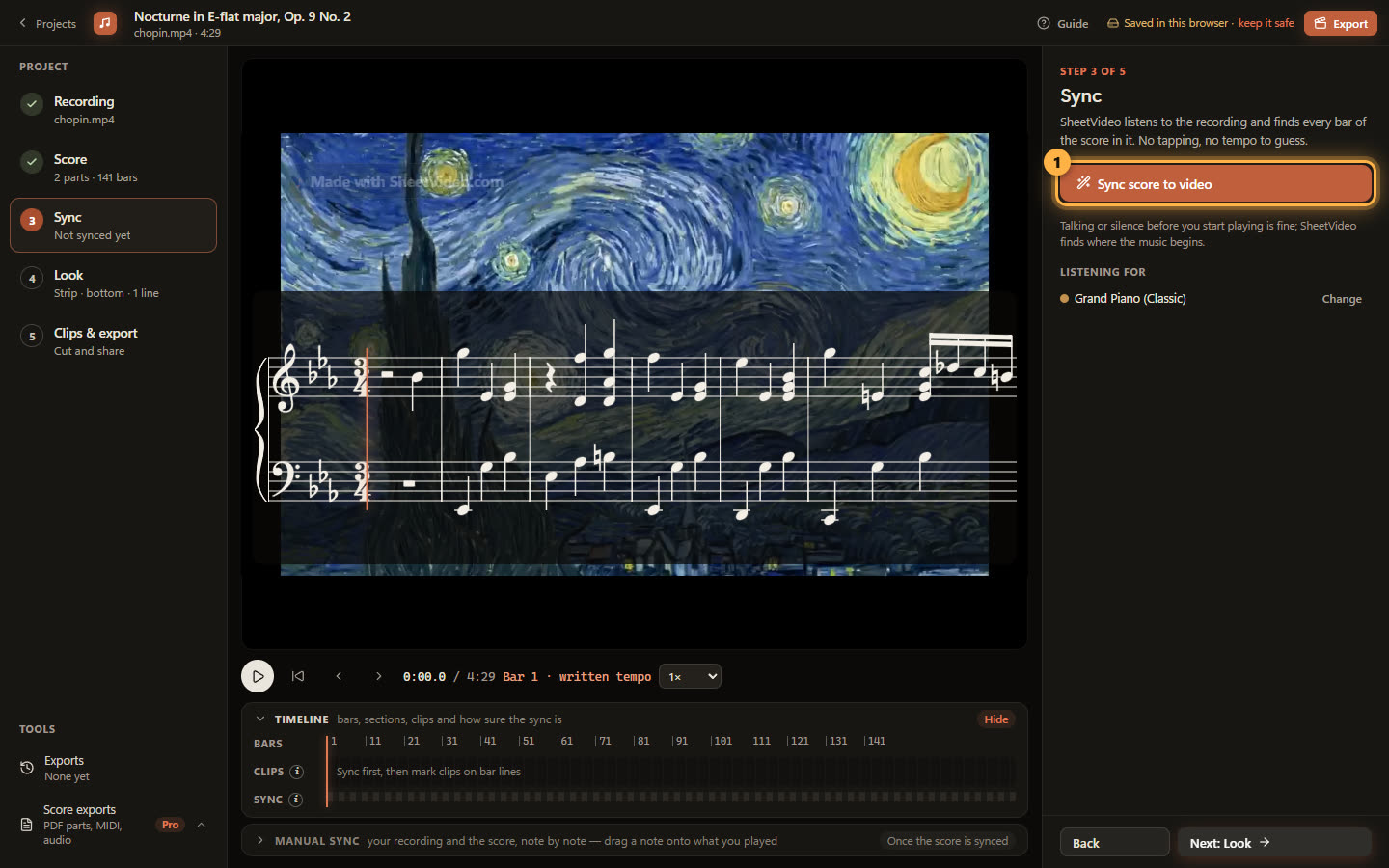
Step 3 is one button. Click Sync score to video.
Under the button it says what it is listening for — the parts you ticked on the Score step. If that is wrong, Change takes you back to them.
7Look at what it flagged
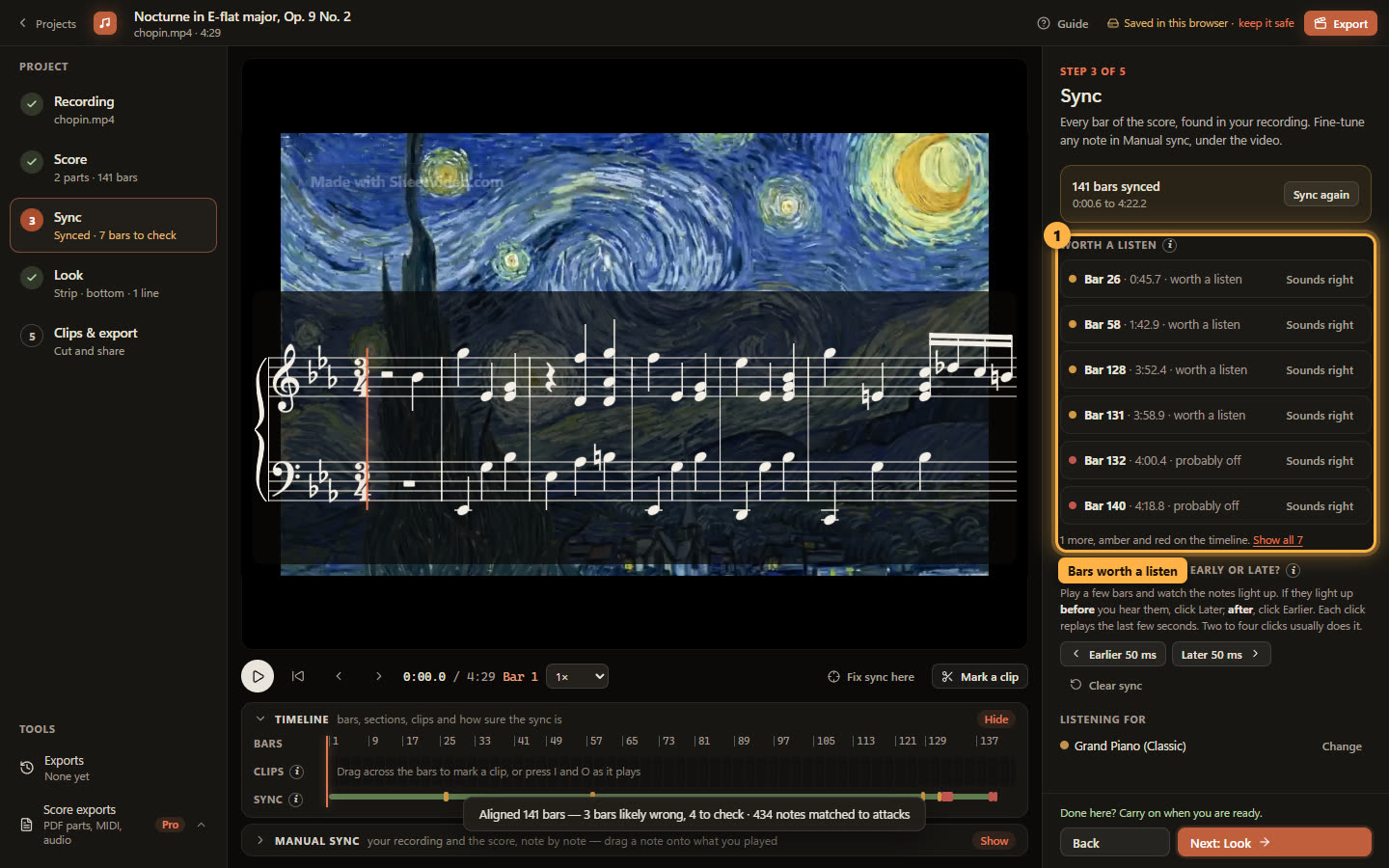
When it finishes, every bar has a place in the recording. The timeline under the video shows it: green where the sync is sure, amber and red where a bar is worth a listen.
The same bars are listed on the right with their times. Click one to jump there and listen; if it sounds right, click Sounds right and it drops off the list. In the Nocturne most of them sit in the closing bars, where the cadenza is played very freely.
8Fix one bar by hand
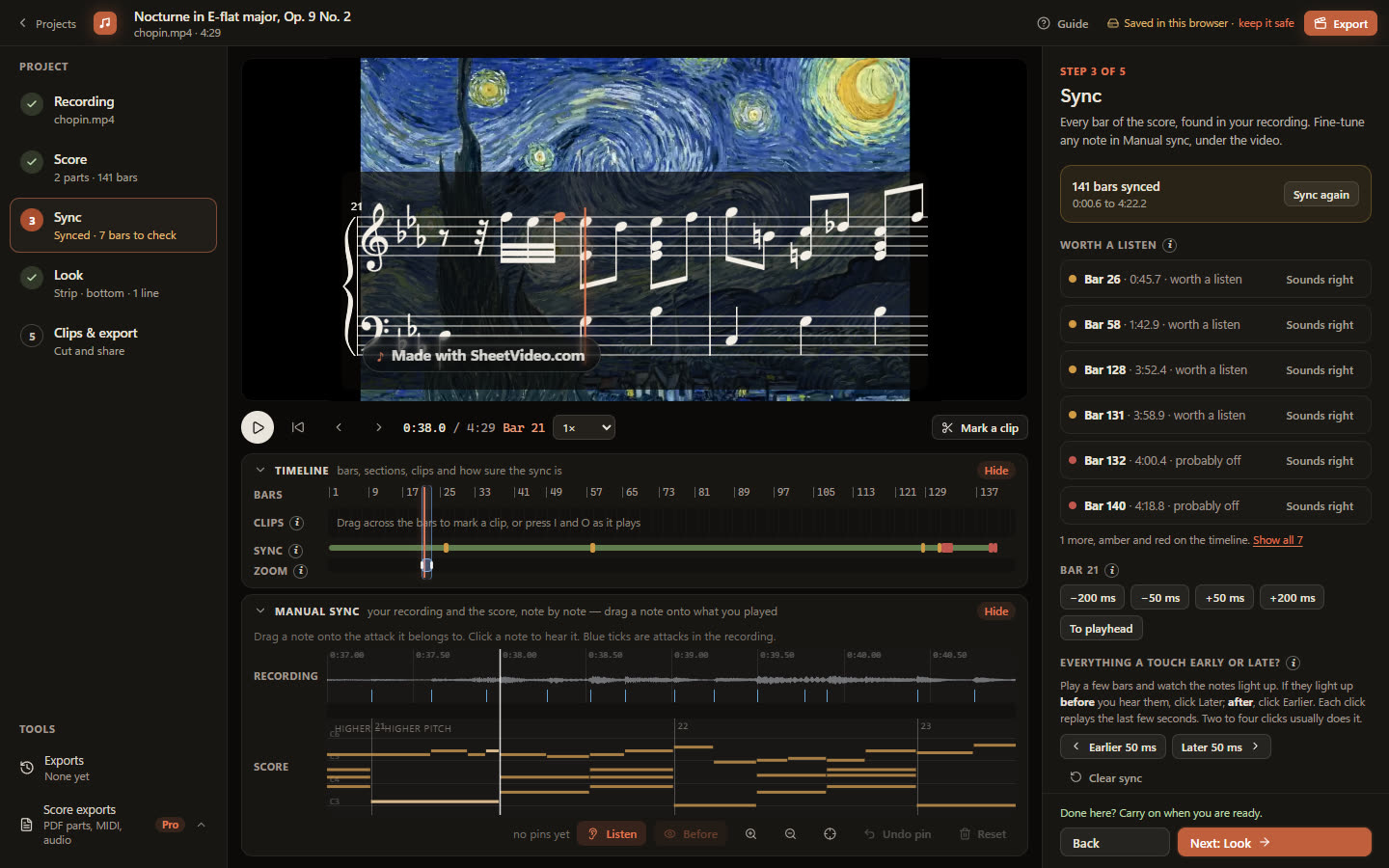
Stop on a bar that is off and click Fix sync here. Manual sync opens under the video: the recording’s attacks across the top, the score’s notes underneath.
Drag a note onto the attack it belongs to and only that stretch moves — the bars either side stay where they are. For a whole bar there are ±50 ms and ±200 ms nudges on the right, and To playhead to snap it to where you have stopped.
9Choose how the score looks
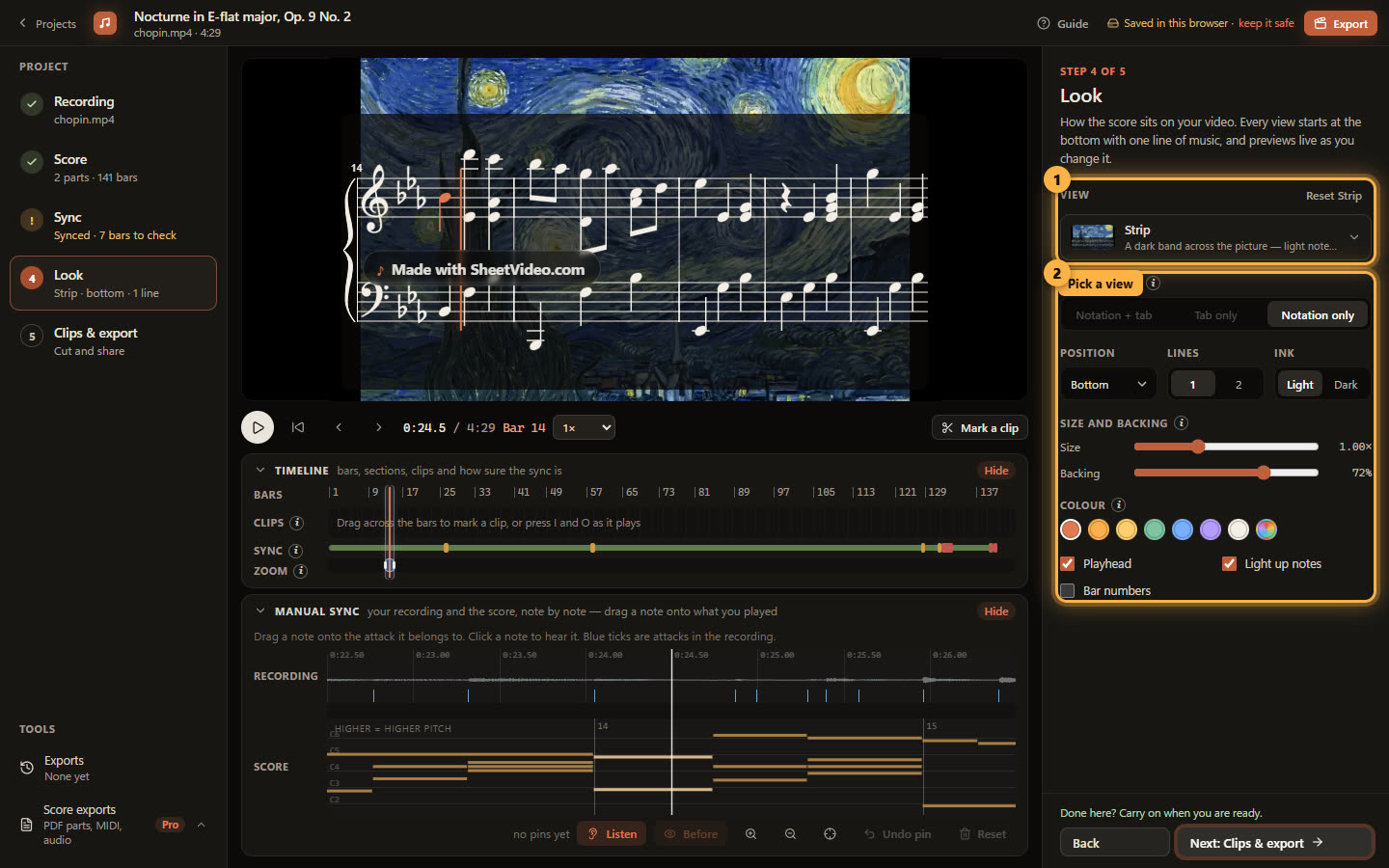
Step 4 is the look. Every project starts on Strip: a dark band along the foot of the picture with light notes, built to read on a phone.
Under the view are the settings it offers — notation, tab or both; top, centre or bottom; one line or two; light or dark ink; size, backing, colour; the playhead, the lit note and bar numbers. The video previews every change as you make it.
10Pick what to export and its shape
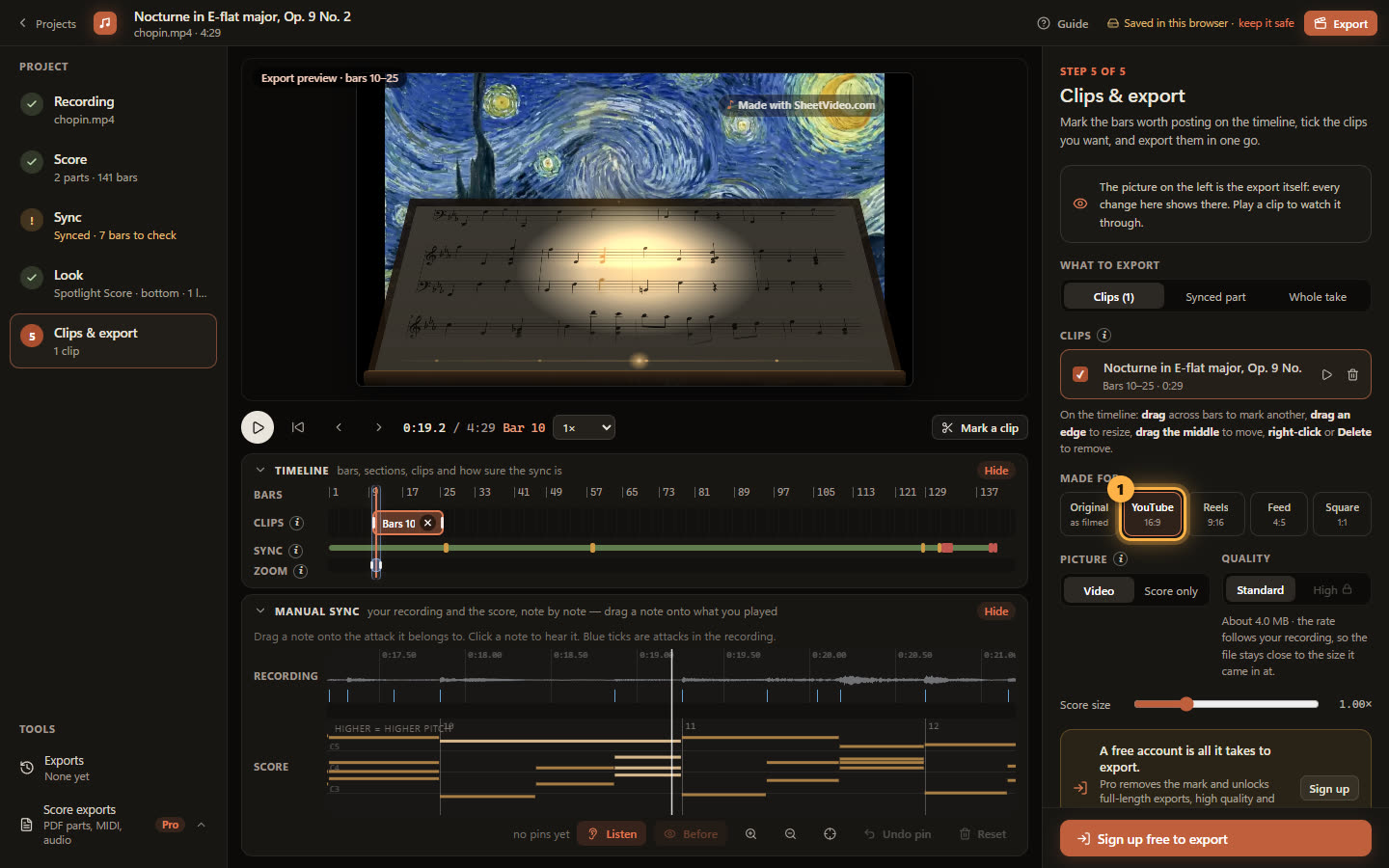
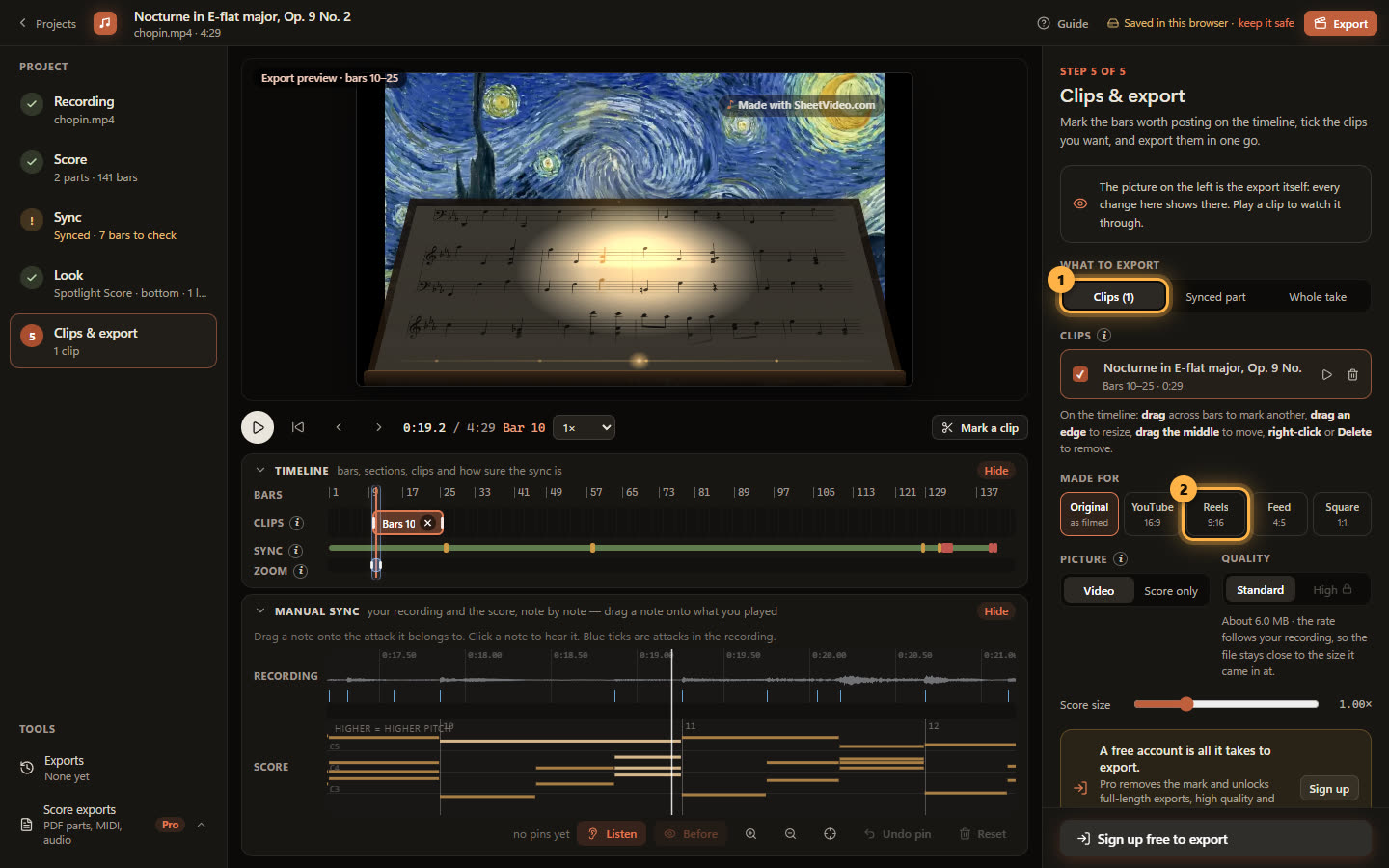
Step 5. What to export: your clips, the synced part, or the whole take. Made for sets the shape: Original (as filmed), YouTube 16:9, Reels 9:16, Feed 4:5 or Square 1:1.
Picture chooses between your video and Score only — your recording’s sound with the score large on a stage of its own. The picture on the left is the export itself, so what you see is what you get.
11Or 16:9 for YouTube
Click YouTube 16:9 for the full-width version, and export the whole take for a performance video — or the synced part, which leaves out anything before the first note and after the last. Same project, same sync: export as many shapes as you like.